


 Thursday , 23 April 2026
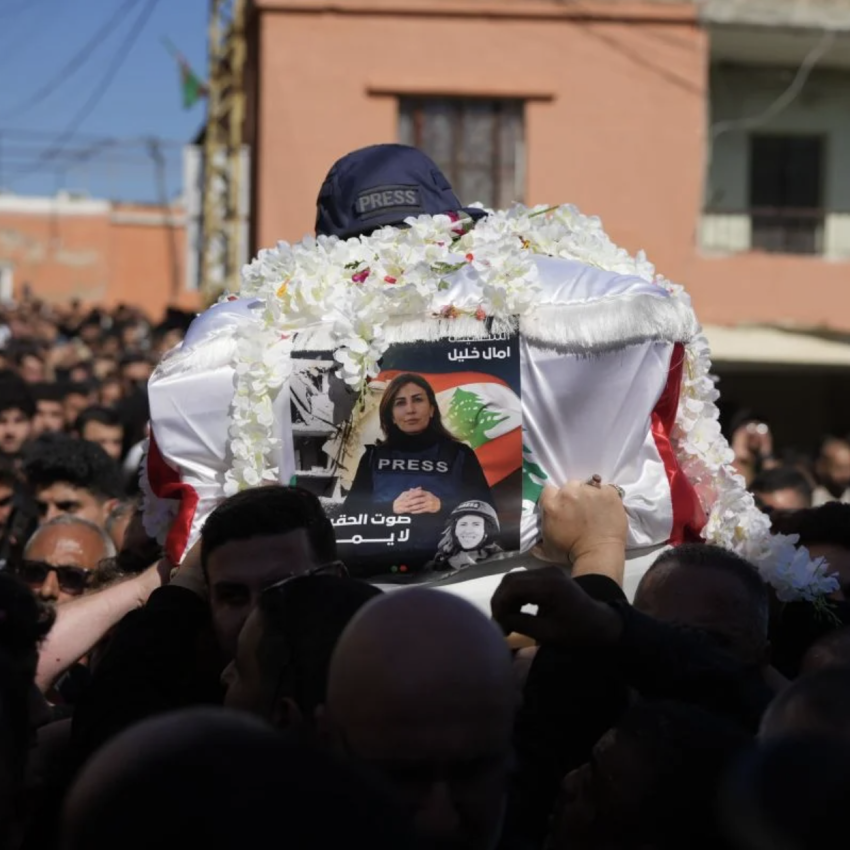
At 11:18 p.m. Beirut time, on April 22, 2026, the daily Al-Akhbar announced that an Israeli strike on Tiri, in the Bint Jbeil district, killed its journalist Amal Khalil, despite the cease-fire.
Khalil had been covering the war in Tiri with photographer Zeinab Faraj when they were caught under Israeli bombardment. According to the newspaper, Khalil was driving behind a car that was targeted by an Israeli drone strike at around 2:45 p.m. The drone strike killed two people.
Five minutes later, she calls colleagues to let them know she's sheltering from the attacks in a nearby building.
The Israeli army subsequently barred ambulances, the Lebanese Red Cross, and the Lebanese Army from entering the area.
A first Red Cross team retrieved the bodies of the victims from the car, but a second attempt to evacuate the journalists was interrupted by another Israeli drone strike.
At 4:27 p.m., an Israeli strike hit the building they had fled to. Rescuers recovered Khalil's body hours later.
On that day, despite a truce that Lebanon is expected to seek to extend for another month, the Israeli army carried out several deadly attacks in south Lebanon and continued demolition operations in the border area it is seeking to turn into a “buffer zone.”
Israeli army 'chased' the two journalists
According to L’Orient Today’s correspondent in south Lebanon, Faraj sustained a minor head injury and a leg fracture.
The Red Cross vehicle transporting her to Tibnin Governmental Hospital was hit by Israeli gunfire, with visible bullet impacts, the state-run National News Agency reported, adding that an Israeli strike targeted the main road linking the town with Haddatha “to prevent ambulance teams from reaching the two journalists”.
The Red Cross later returned to the scene with an excavator to clear the debris and recover Khalil’s body.
In a statement, the Health Ministry said the Israeli army “chased” the two journalists after the first strike, targeting the house where they had taken refuge.
It also said Israel obstructed the Red Cross mission by “throwing a stun grenade at the ambulance and targeting it with gunfire,” preventing Khalil's recovery. The ministry called on the United Nations and international bodies to “put an end to this inhumane violation.”
The Israeli military claimed it had struck a vehicle leaving a Hezbollah “military structure” in Tiri, and later targeted the structure itself.
Its Arabic-language spokesperson said the Israeli army struck the vehicle and then a building where the individuals had taken refuge, claiming that the army “does not target journalists” and seeks to minimize harm to them while ensuring the safety of its forces.
Last month, an Israeli attack on a clearly marked press vehicle killed three journalists in southern Lebanon.
In February, the Committee to Protect Journalists reported that Israeli attacks had killed two-thirds of the 129 journalists and media workers killed in the course of their work in 2025. It was the second year running in which Israel was responsible for roughly two-thirds of the total.
Israel was responsible for 81% of the 47 killings that the CPJ classified as intentionally targeted, or “murder,” adding that the actual figure was probably higher, owing to access restrictions that made verification difficult in Gaza.
Death threat in 2024
Lebanese officials stepped up contacts following the incident. President Joseph Aoun called for the mobilization of the Red Cross in coordination with the army and U.N. peacekeepers, urging the protection of journalists.
Prime Minister Nawaf Salam spoke with the command of the U.N. Interim Force in Lebanon, while Information Minister Paul Morcos cited “intensive and urgent contacts.”
The Press Syndicate denounced a “blatant violation of international law” and an attempt to intimidate the media. The Committee to Protect Journalists said it was “outraged” and recalled that Khalil had received a death threat in September 2024 attributed to the Israeli army, raising “serious concerns about possible deliberate targeting.”
At the time, she said she had received a warning to leave the South, with threats to destroy her home and behead her.
Morcos expressed “deep sadness” over Khalil’s death, saying she was “targeted by the Israeli army while carrying out her professional duty.”
“Targeting journalists is a serious crime and a flagrant violation of international humanitarian law,” he said.