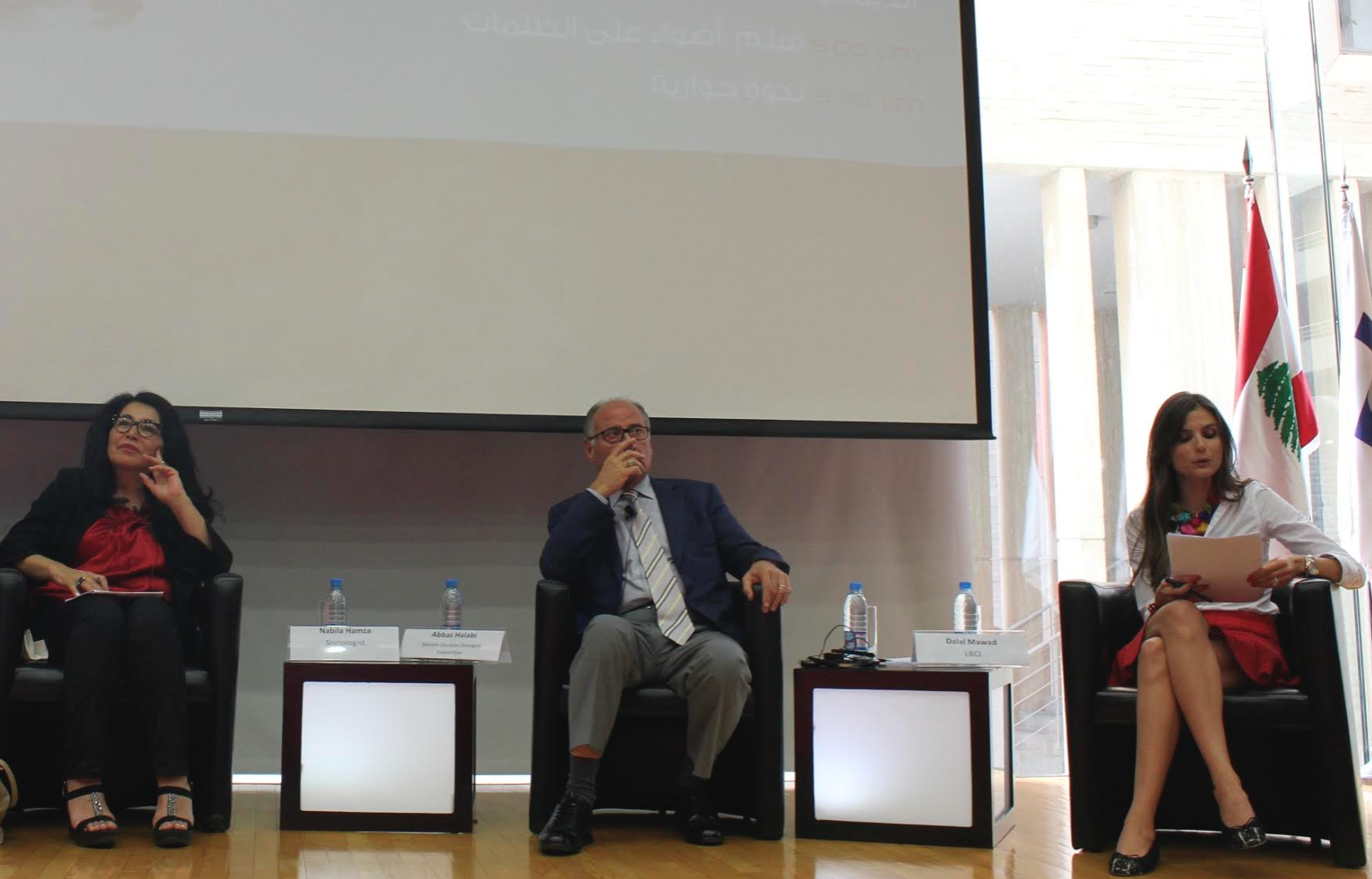
“Can we build democratic systems in which Islamist parties can take part?” asked Dalal Mawad, a journalist for LBCI, to frame a panel discussion on Democracy and the Religious Challenge. The discussion took place on May 25 at the Université St-Joseph as part of the Beirut Spring Festival, which is being organized to commemorate Samir Kassir’s legacy on the 10th anniversary of his assassination. The event was held in partnership with the Friedrich Naumann Foundation.
The event began with a screening of the short documentary “Lights on Darkness,” which looks at the phenomena of female and child suicide bombers in Iraq and how radical Islamist groups use poverty, social vulnerability and conservative gender norms to manipulate women and children into aiding and participating in suicide operations.
The movie, shot in 2010 and 2011, is the first in a three part series reported by Lebanese journalist Diana Moukalled. The series looks at radicalization in Iraq, Jordan and Egypt.
Following the screening Moukalled engaged in a question and answer session with Mawad and members of the audience.
Moukalled addressed the evolution from the Al-Qaeda networks that were behind the suicide bombings at the time she reported the documentary to the so called Islamic State (IS), which is operating in similar areas of Iraq today. “Some people thought IS fell from the sky, but others looked deeper,” she said, noting that many of IS’s leaders had been involved in the previous cycles of violence in Iraq.
In response to a question about whether radicalization stemmed more from poverty and marginalization or ideology, Moukalled emphasized that the absence of female agency in highly conservative areas of Iraq means that women are often manipulated by patriarchal control into participating in operations. “Ideology is not the main factor because [women] are not their own decision makers,” she said.
Moukalled also criticized the response to IS in Iraq, saying that the Shia militias fighting to retake the predominantly Sunni areas under IS control are also guilty of atrocities. “You can’t counter terrorism with terrorism,” she emphasized.
After the question and answer session, the panel discussion on Democracy and the Religious Challenge began. The panelists consisted of Abbas Halabi of the Muslim Christian Dialogue Committee, Nabila Hamza, a Tunisian sociologist, Farid El-Khazen, a Lebanese parliamentarian, and Sven Speer, Chairman of the Religious Policy Forum. Mawad moderated the discussion.
Hamza began by discussing how the repression of Islamists in Tunisia made them an essential part of the democratic opposition to authoritarian rule in the country. In the 1980s, Islamists tried to organize a united front with liberals to oppose authoritarian rule. When the revolution happened in 2011, it was natural that an important part of the opposition became a major force in the new political arena, she said.
Dalal then directed a question to El-Khazen about whether oppression also contributed to the rise of the Muslim Brotherhood in Egypt to power after the fall of Mubarak.
El-Khazen replied that there were many factors involved including the absence of a secular alternative and the Islamicization of society that took place under Mubarak. “The Muslim Brotherhood were the most prepared to arrive to power,” El-Khazen said.
The conversation then switched to the compatibility of religions and democracy. “Religions, in their essence, are not democratic,” Halabi said, arguing that democracy is a modern idea.
Speer countered saying that religious parties were major political players in Germany following World War Two. Liberal and socialist parties felt threatened by them, but they learned they had to work together because of their common experience of repression under the NAZI regime, he added.
Dalal then asked the panelists to compare the Tunisian and Egyptian experiences.
“We cannot talk about political Islam as one homogenous pack,” Hamza replied. The moderate Islamist party in Tunisia is now an integral part of the democracy. However, they made a lot of mistakes after winning the first post-revolution elections by pushing for the Islamicization of society. Secularist pushed back and prevented this from happening, she said.
“Democracy is used by Islamists to arrive to power,” El-Khazen said, arguing that once they are in power they pursue their agenda that runs against liberal democratic values.
“In general I agree with you,” Hamza responded. “But, Tunisia is an exception.”
The rest of the Arab world does not have the history of secularization that Tunisia has, Halabi argued. The Egyptian constitution sites Sharia as the source of legislation while the Tunisian constitution safeguards against Islamicization, he said.
The discussion later shifted to the Lebanese model of consociational democracy. Dalal asked the panelists if they still believed in the model.
Halabi said that the model is a result of Lebanon’s communal and social reality and cannot be measured by global standards. “It has guaranteed the rights of all sects,” he said, adding that the problem is the ruling elite and not the old_paradigm.
After an exchange between Halabi and El-Khazen on the subordination of individual rights to sect rights, Speer noted that Lebanon, and other Middle Eastern societies, are not the only ones with communal divisions. “You see a deep confessional divide in Germany as well,” he said. The question is whether the state empowers communities or individuals, he added.
In the end, the panelists seemed to agree that it wasn’t religion itself that was an impediment to democracy but the way the religion is being instrumentalized for political purposes that poses a threat. “Islam is being… used as a tool in a political conflict,” Halabi concluded.