


 Tuesday , 10 March 2020
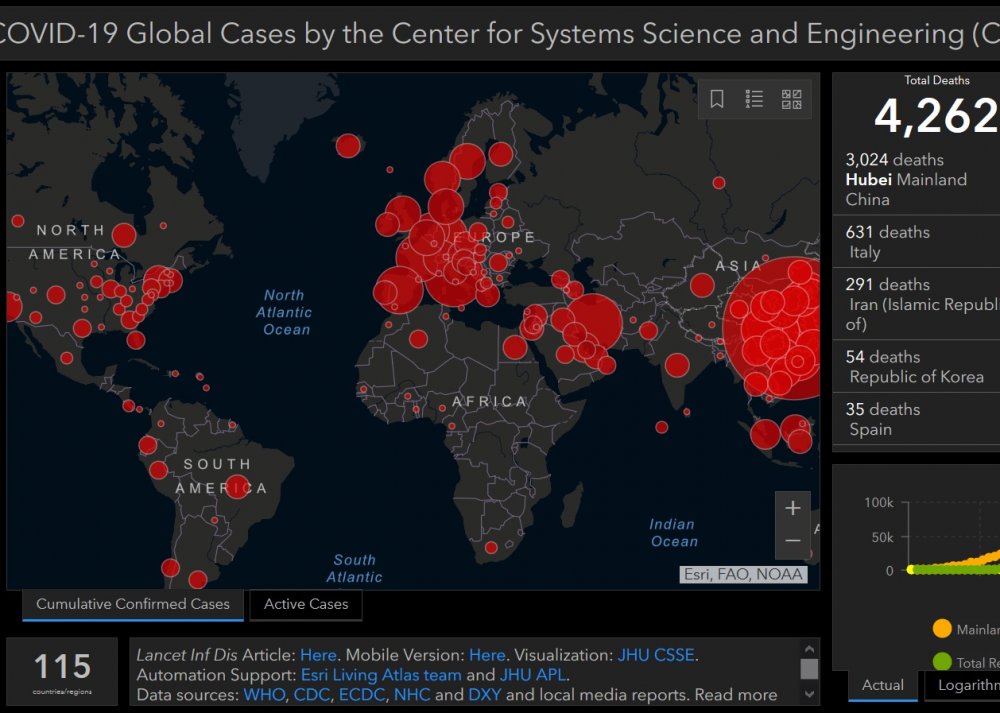
The new coronavirus has already become the biggest story in our world — reaching more than 100 countries, killing 4,262, and infecting more than 118,101, according to the latest numbers from the Johns Hopkins University & Medicine COVID-19 map. This global public health emergency — one of the six declared in recent years by the World Health Organization (WHO), beginning with the 2009 Swine flu — has already wiped out billions of dollars from the global economy, and according to Bloomberg could eventually cost the economy a total of $2.7 trillion.
Despite all these numbers and estimates, it is difficult to fathom how far COVID-19 might spread, and what the ultimate consequences will be. With all the uncertainties, journalists around the world are faced with the many challenges of covering the epidemic — including combating misinformation and health risks to reporters in the field — while not fueling panic.
To support journalists in their coverage, GIJN’s Miraj Chowdhury pulled together advice from various journalism organizations, experienced journalists, and experts. We plan to continue rolling out resources for reporting, including guides in GIJN’s regional languages and on our social media channels. For now, you can find our Bangla COVID-19 guide here, a story from GIJN-Chinese about COVID-19 visualizations in Chinese media, and investigative tips from infectious disease expert Thomas Abraham, author of books on SARS and polio.
In her latest research, Karin Wahl-Jorgensen, a journalism professor at Cardiff University, examined how fear has played a role in COVID-19 coverage in 100 high circulation newspapers from around the world. She found that one out of every nine stories on the outbreak mentioned “fear” or related words, including “afraid.”
“These stories often used other frightening language as well; for example, 50 articles used the phrase ‘killer virus,’’’ she writes in this Nieman Lab article.
So, how can we avoid spreading panic while continuing to provide deep and balanced coverage? According to Poynter’s Al Tompkins (who plans to put out a daily newsletterabout COVID-19), the solution is responsible reporting. Here is a summary of his suggestions:
In another Poynter piece, Tom Jones emphasizes finding the facts, but not the speeches. “It’s a science story, not a political one,” he writes. Of course, politics matter, but be alert for COVID-19 spin from partisan political sources, and rely upon medical experts.
Since the outbreak, reporters have been using different names for the virus. For example, “the coronavirus,” “a coronavirus,” “new coronavirus,” or “novel coronavirus.” “That’s because this coronavirus is separate from other coronaviruses that have caused their own epidemics or pandemics. Each gets a name, and each was new (or novel) at some point,” says Merrill Perlman in a recent CJR article. Want to know more about names? Read WHO’s explanation about why viruses have different names.
How should you name the outbreak? CNN is using the term pandemic to describe the current coronavirus outbreak. They explained, why. But WHO does not call it a pandemic yet, and they have their reasons, too. [Editor’s note: WHO has updated its assessment and, as of March 11, are now naming COVID-19 a pandemic.]
Words matter. According to the AP Stylebook, “epidemic is the rapid spreading of disease in a certain population or region; a pandemic is an epidemic that has spread worldwide.” They suggest to “use sparingly; follow declarations of public health officials.” You’ll find other tips in the AP Stylebook on Coronavirus.
In a global outbreak of disease, journalists cannot cover the story from self-quarantine. We need to go to the field, and there are risks of being infected. The Committee to Protect Journalists (CPJ) issued a detailed advisory for journalists covering COVID-19 which includes pre-assignment preparations, tips for avoiding infection in affected areas, travel planning, and post-assignment cautions. Here’s a summary of its key tips for field coverage:
To stay up-to-date, check the websites of WHO, the US-based Centers for Disease Control and Prevention (CDC), and the United Kingdom’s Public Health England (PHE). Also recommended are the Johns Hopkins University and Medicine COVID-19 map its coronavirus resource center, and newsletter updates. Follow the government agencies in your country that are responsible for providing information on the outbreak.
The Journalist’s Toolbox, by The Society of Professional Journalists, has listed key resources and sources. Here are a few:
For more, check out this webinar by the Washington, DC-based National Press Club or this one by the University of Southern California Annenberg’s Center for Health Journalism.
Experts on the disease are not easy to find. The virus is unknown and unpredictable, and there aren’t enough researchers or doctors specialized on COVID-19. When choosing experts, consider five suggestions by William Hanage, associate professor of epidemiology at Harvard’s T.H. Chan School of Public Health:
Check out these tips from GIJN’s Q&A with Thomas Abraham, a veteran health journalist, an expert on infectious disease and global health security, and the author of “Twenty-first Century Plague: The Story of SARS” and “Polio: The Odyssey of Eradication.”
Caroline Chen covers health care for ProPublica. She survived the SARS outbreak in Hong Kong at the age of 13, and later, as a reporter, covered SARS and Ebola from the front lines. In this article, Chen focuses on what to ask when covering COVID-19; how to keep things accurate when dealing with estimates, projections, and fast-changing information; and how to stay safe, above all.
John Pope, a reporter with two decades’ experience in health issues, wrote up 11 tips to cover swine flu, which you may find relevant for the COVID-19 as well. His tipsheet includes — among others — the importance of getting the basic facts first, mapping the outbreak, keeping things simple and concise, emphasizing prevention, and to watch the language.
IJNet has compiled a list of tips for reporting on COVID-19 with advice from journalists who have covered the disease. Here are the key points:
“We’re not just fighting an epidemic; we’re fighting an infodemic,” said WHO Director General Tedros Adhanom Ghebreyesus at the Munich Security Conference on February 15. In this age of mis- and disinformation, online myths and conspiracy theories, journalists may also be debunking bad information, such as the disease being transmitted through goods manufactured in China, that scientists created COVID-19, or that it came from a particular research lab.
In a recent article, Poynter noted that people in at least five countries — including the US, India, Indonesia, Ghana, and Kenya — saw or read about a hoax that “the Chinese government had turned to the Supreme Court to request authorization to kill 20,000 people infected with the coronavirus 2019.”
For debunking and fact-checking, check out the initiative by the International Fact-Checking Network which includes 90 fact-checkers from 39 countries who are collaborating to combat this tsunami of falsehood. By the end of February, the #CoronaVirusFacts / #DatosCoronaVirus alliance has published 558 fact-checks on the disease. WHO has a “Myth Busters” page that debunks rumors on coronavirus which includes shareable images for everyone, including journalists and media organizations. AFP has also launched a similar initiative named “Busting Coronavirus Myths.” It’s always worth seeing what advice First Draft is serving up, including its latest article on slowing the spread of misinformation and this one on quick ways to verify content online. [Editor’s Note: First Draft has now added Coronavirus: Resources for Journalists.]
There are many media houses around the world which don’t have fact-checking teams or even a person with debunking skills. If you find hoaxes or suspicious information, reach out to well-established and credible local and regional fact-checking groups for help. Typically they are active on social media and are always looking for leads.
We always need to find human faces, visit homes and workplaces, and ask people uneasy questions for our stories. But in a global outbreak like this, victims are traumatized. They may not want to be identified and discuss infections. Even naming where the victim lives can spread panic in that community, leaving the victim’s family even more insecure.
The Dart Center for Journalism & Trauma has assembled a list of resources on COVID-19 reporting. It includes guides, tipsheets, advisories, best practices, and advice from experts on interviewing victims and survivors, and working with colleagues exposed to traumatic events. This article from the Center for Health Journalism also includes lessons for interviewing trauma survivors. Here’s a summary of tips:
Dart’s final tip is advice we should all heed:
“Take care of yourself, too.”