


 Wednesday , 18 February 2026
Facts
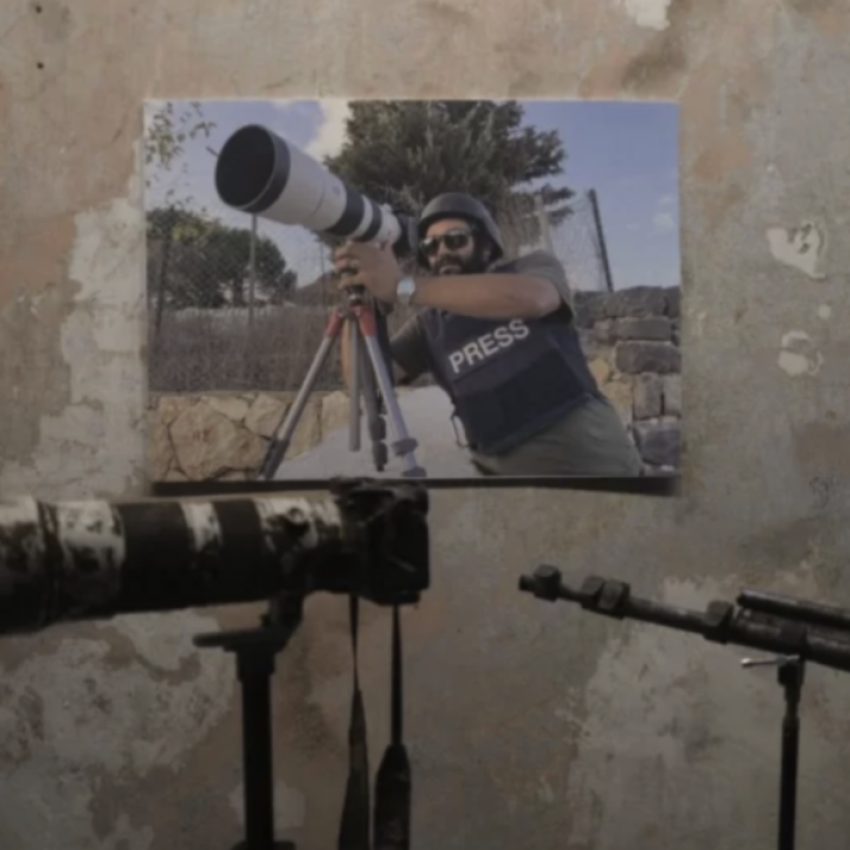
On 13 October 2023, Israeli army strikes near the southern Lebanon border killed Issam Abdallah, a Reuters journalist, and injured six other journalists, namely Thaeir Al Sudani and Maher Nazeh (also Reuters), Dylan Collins and Christina Assi (Agence-France Presse), and Carmen Joukhadar and Elie Brakhia (Al Jazeera).
A number of actors, including the United Nations Interim Force in Lebanon (UNIFIL), have reported on this matter. While the UNIFIL report has not been made public, Reuters has seen the report and published a summary of it.[1] According to the Reuters summary, an Israel Defence Forces (IDF) Merkava tank fired two 120 mm rounds in quick succession from the Israeli side of the Blue Line at a group of “clearly identifiable journalists”. UNIFIL personnel did not record any exchange of fire across the border between Israel and Lebanon for more than 40 minutes prior to this incident.
Reports on the case suggest that the first tank shell killed Issam Abdallah and seriously injured AFP correspondent Christina Assi, while the second directly struck and destroyed one of the journalists’ vehicles. These reports also suggest that all of the journalists were wearing identifiable vests with press signs and that a TV sign was visible on the roof of the vehicle which was struck.[2] According to Reuters, IDF spokesperson Nir Dinar said Hezbollah had attacked the IDF near the Israeli community of Hanita on 13 October, and the IDF responded with artillery and tank fire to remove the threat and subsequently received a report that journalists had been hit.[3]
The day after the incident, Lebanon’s Ministry of Foreign Affairs and Emigrants reportedly instructed Lebanon’s Permanent Mission to the United Nations in New York to submit a complaint to the UN Security Council regarding the incident.[4] It does not appear that the Security Council responded, in case such a complaint was indeed submitted.
On 16 October 2023, the UNESCO Director-General, Audrey Azoulay, issued a statement condemning Abdallah’s killing and calling for “a full and transparent investigation to determine the circumstances of this tragedy”.[5] In February 2024, a group of over 120 organisations wrote to Audrey Azoulay and Volker Türk, the UN High Commissioner for Human Rights, calling for an independent investigation into Israel’s targeting of journalists in south Lebanon, including the Issam Abdallah case.[6] It is not clear if this call has been acted upon.
On 13 November 2023, the UN Special Rapporteurs on Freedom of Opinion and Expression, on Extrajudicial, Summary or Arbitrary Executions and on Human Rights Defenders sent a joint communication to the Israeli government detailing concerns over the attack, calling on Israel to “conduct a thorough, independent and prompt investigation into the allegations above and to take most robust measures to ensure that civilians and journalists are not targeted”, and asking for a response from Israel within 60 days.[7] To date, no response to this communication has been received.[8]
In April 2024, Lebanon’s caretaker cabinet instructed the Ministry of Foreign Affairs to submit a declaration under Article 12(3) of the Rome Statute of the International Criminal Court (ICC) accepting the ICC’s jurisdiction to investigate and prosecute alleged war-crimes committed on Lebanese territory since 7 October 2023.[9] However, by late May 2024 the Lebanese government reversed course and thus did not submit the required declaration to the ICC.[10] On the second anniversary of Issam Abdallah’s death, in October 2025, the Lebanese cabinet tasked the Ministry of Justice with exploring “appropriate judicial measures” against Israel for attacks on journalists, specifically referencing the case of Abdallah and his colleagues.[11]
On 19 July 2024, Issam Abdallah’s family filed a submission regarding the attack with the United Nations Independent International Commission of Inquiry on the Occupied Palestinian Territory, including East Jerusalem, and Israel (COI).[12] The COI was established by a Human Rights Council Resolution in May 2021 and has a mandate “to investigate in the Occupied Palestinian Territory, including East Jerusalem, and in Israel all alleged violations of international humanitarian law and all alleged violations and abuses of international human rights law leading up to and since 13 April 2021, and all underlying root causes of recurrent tensions, instability and protraction of conflict”.[13] Given that the actions which led to the incidents of 13 October 2023 took place on the Israeli side of the Blue Line, and the wider implications of the situation in Lebanon for Palestine, the COI may well deem this matter to fall within its jurisdiction. However, the most recent annual report of the COI, issued on 6 May 2025, did not mention the Issam Abdallah case.[14]
From 29 September to 10 October 2025, the United Nations Special Rapporteur on Extrajudicial, Summary, or Arbitrary Executions, Dr. Morris Tidball-Binz, conducted a country visit to Lebanon. The Preliminary Observations issued at the end of the mission highlighted the facts of the attack on Abdallah and his colleagues, and suggested that it raised “serious concerns under international humanitarian law, including the prohibition of attacks directed against civilians, and the principles of distinction, proportionality, and precaution”.[15] The final report on this visit will be presented to the 62nd session of the UN Human Rights Council, in June 2026.[16]
On 10 December 2025, Issam Abdallah’s family also filed a complaint with the UN Special Rapporteur on Extrajudicial, Summary or Arbitrary Executions, and the UN Special Rapporteur on Truth, Justice and Reparations, regarding the ongoing failures by Israel and Lebanon to conduct an independent investigation into the circumstances of Issam Abdallah’s killing.[17]
Options for Redress: Hard Accountability
International law provides for only limited options for “hard” or legal accountability (i.e. before courts or quasi-judicial bodies) for human rights or humanitarian law breaches, or international crimes. Those are canvassed here, while a number of softer options, some of which have already been tried or are in progress, as outlined above, are canvassed in the following section.
International Criminal Court
The International Criminal Court (ICC) is one of the few international jurisdictions which can hear individual criminal cases against individuals for breach of international criminal law. While the convention establishing the ICC, the Rome Statute of the International Criminal Court (Rome Statute), formally lists four types of crimes which fall within the jurisdiction of the Court,[18] the category of war crimes is most relevant here, although murder, when committed as part of a widespread or systematic attack directed against any civilian population, and with knowledge of the attack, can also qualify as a crime against humanity.
A conviction under the Rome Statute requires that an individual both committed the act in question (in this case, murder or wilful killing) and did so intentionally, meaning that the person committed the act itself intentionally and that he or she meant to cause the result or was aware that it would occur in the ordinary course of events (Article 30). Liability can extend not only to the person(s) who commits the act but also those who order, solicit or induce the commission of the crime, or aid, abet or otherwise assist in its commission (Article 25), as well as to commanders and superiors (Article 28). Intention is required for all of these other acts, so that a soldier who merely helps load a round of artillery into a weapon but does not know that it will be used improperly would not be liable. It is not clear from the facts of this case how far liability would or might extend but likely only to those who could be proven to have acted in the knowledge that the targets of their actions were civilians.
Jurisdiction under the ICC in most cases rests on the fact that the crime took place in or was allegedly committed by a national of a State which is either a party to the Rome Statute or has accepted the jurisdiction of the ICC (Article 12). Since the impugned acts took place in Lebanon, Lebanon is entitled to accept the jurisdiction of the ICC pursuant to Article 12(3) of the Rome Statute. Although that provision refers to States accepting the jurisdiction of the Court “with respect to the crime in question”, Rule 44(2) of the Court’s Rules of Procedure and Evidence[19] makes it clear that the acceptance of jurisdiction must relate to a “situation” and, pursuant to such an acceptance, the Court will have jurisdiction over all crimes committed in relation to that situation.
In the case of Situation in the Republic of Côte D’Ivoire in the Case of the Prosecutor v. Laurent Gbagbo, before Pre-Trial Chamber I of the ICC, the Court was called upon to assess the scope of an Article 12(3) declaration in which Côte D’Ivoire accepted “the jurisdiction of the Court over crimes committed on its territory since the events of 19 September 2002”. As part of its reasoning, the Court noted:
[W]hile States may indeed seek to define the scope of its acceptance, such definition cannot establish arbitrary parameters to a given situation as it must encompass all crimes that are relevant to it. Contrary to the Defence submission, the Chamber is of the view that it will be ultimately for the Court to determine whether the scope of acceptance, as set out in the declaration, is consistent with the objective parameters of the situation at hand.[20]
Looking at the facts of that situation, an ongoing political disruption which involved violent incidents and attempts to seize power over a period of time, the Court accepted the views of an earlier Chamber that the “situation” in question in that case went on for years, quoting the earlier Chamber as saying:
[T]he violent events in Côte d'lvoire in the period between 19 September 2002 and 28 November 2010, although reaching varying levels of intensity at different locations and at different times, are to be treated as a single situation, in which an ongoing crisis involving a prolonged political dispute and power struggle culminated in the events in relation to which the Chamber earlier authorised an investigation.[21]
While it is not possible to pre-judge how the Court might interpret the “situation” in the context of this case, it seems likely that it might view it as the entire sequence of events relating to the armed conflict between Israel and Lebanon which was triggered by the events of 7 October 2023 and in which the attacks on Issam Abdallah and his colleagues took place. This might explain Lebanon’s reconsideration of its willingness to accept the jurisdiction of the ICC since, in case the Court does interpret the nature of the situation broadly, it might also look into alleged war crimes committed by Lebanese actors.
As noted in the facts above, Lebanon was initially considering accepting the jurisdiction of the ICC so as to have it investigate the Issam Abdallah case, but it then decided not to proceed with that. For its part, Israel has not accepted the jurisdiction of the ICC. As such, presently, the ICC does not have jurisdiction over this case.
In addition, the ICC cannot assume jurisdiction over a case which is being investigated or prosecuted by a State which has jurisdiction over it, unless the State is unwilling or unable to carry out the investigation or prosecution (Article 17). It is not clear whether Israel is conducting a genuine investigation into this case[22] but it does not appear to have lodged any prosecution relating to it.
Finally, Article 17(1)(d) of the Rome Statute provides that a case is inadmissible where it is “not of sufficient gravity to justify further action by the Court”. There are a number of rationales for this, including the limited capacity of the ICC to address the large number of crimes which might otherwise fall within its jurisdiction. The “gravity” admissibility requirement applies both to the situation referred to the Court and to individual cases which the prosecutor is seeking to investigate. Beyond gravity as an inadmissibility criterion, gravity also plays a second role as “the predominant case selection criteria” used by the prosecutor when deciding whether or not to investigate a particular case.[23] Gravity is a complex factor at all three levels described above. Here, it would be assessed for admissibility purposes in relation to the wider situation being referred to the Court, assuming there was such a reference, and the various cases within that situation, including the case of Issam Abdallah and his colleagues, as well as by the prosecutor as a case selection criterion.
International Human Rights Bodies
Several international human rights treaties allow for individuals to lodge complaints alleging that States have abused their human rights. Thus, the (first) Optional Protocol to the International Covenant on Civil and Political Rights (ICCPR)[24] allows for such procedures in respect of the ICCPR. Cases are decided by the UN Human Rights Committee, the body which oversees compliance with the ICCPR, which issues non-binding “Views” as its decisions in these cases. Similar procedures exist for the International Convention on the Elimination of all Forms of Racial Discrimination (ICERD)[25] and the Convention against Torture and Other Cruel, Inhuman or Degrading Treatment or Punishment (CAT).[26]
However, these procedures only apply where States have accepted them. Neither Lebanon nor Israel have accepted the individual complaints procedures under any of these treaties, although both countries are parties to all three treaties.
Various international human rights treaties also allow for inter-State communications about failures to respect their provisions. This is provided for, for example, in Article 41 of the ICCPR, which allows for States which consider that other States are “not giving effect to the provisions of the present Covenant” to bring that matter to the attention of the other State via a written communication. If the matter is not resolved between the two States within six months, either State may refer the matter to the Committee, which can then try to mediate a solution and, failing that, may issue a report setting out the facts and with the statements of the involved States attached (but not its own decision, unlike in an individual communication).
Under Article 41 of the ICCPR and Article 21 of CAT, this procedure may only be used where both States have accepted the application of this procedure to themselves. Neither Israel nor Lebanon have done that. However, no such acceptance is required under Article 11 of the ICERD, which also has a more complex procedure for such communications.
Under the ICERD, first, as under the other treaties, this procedure can apply only if all domestic procedures have been exhausted, although the human rights treaty oversight bodies (and international courts) do not impose this requirement if it is illusory or ineffective, which would be arguable here. Once the Committee on the Elimination of Racial Discrimination (the ICERD oversight body) has collected the relevant information, it creates an ad hoc Conciliation Commission (Article 12) which considers the matter and reports back to the Committee on its findings of fact and recommendations for resolving the matter. The disputing States then have three months to decide whether or not they accept the recommendations of the Commission, following which the Commission’s report is forwarded to all States Parties to the ICERD. This is closer to a decision than the ICCPR procedure, although not quite the same as the adoption of “views” in response to an individual communication.
For purposes of the present case, it may be noted that ICERD only addresses situations of discrimination “based on race, colour, descent, or national or ethnic origin”. Any pursual of this inter-State procedure would therefore need to be based on a breach of rights covered under that Convention (i.e. those relating to the non-equal respect of human rights based on the grounds listed).
Universal Jurisdiction
The doctrine of universal jurisdiction establishes an obligation on all States to adopt legislative regimes so as to be able to prosecute certain crimes regardless of where they occurred or the nationality of the perpetrator. An early version of this was found in the 1949 Geneva Conventions, which called on all States to adopt legislative regimes so as to be able to prosecute “grave breaches” of their provisions, regardless of the nationality of the perpetrator.[27] This has now evolved to encompass war crimes.[28] This exception to the normal approach, whereby States only prosecute crimes which take place on their territory, which involve their citizens as perpetrators or victims, or which involve important interests of the State, normally relating to security, is based on the idea that certain crimes are so grave that they affect the international community as a whole. In practice, many States have put in place some system for asserting universal jurisdiction.[29]
There are practical barriers to pursuing accountability via this approach, the first being the ability to secure the evidence required to pursue a criminal case, including as to the intention of the accused person(s) in committing the acts in question. Despite this, the rate of such prosecutions is increasing globally.[30] A prosecution under a universal jurisdiction regime could theoretically be pursued in Lebanon[31] or another country.
Options for Redress: Soft Accountability
There are a number of soft mechanisms for accountability regarding the case of Issam Abdallah and his colleagues. One of these is the regular or periodic reviews which take place under different human rights treaties. The most relevant one for current purposes is the ICCPR review. Civil society organisations (CSOs) can make submissions to these reviews on any human rights issue covered by the ICCPR which they wish to. Prior to the actual hearing on the review, the Human Rights Committee (HRC) usually adopts a list of issues for consideration (again, CSOs can make submissions on what should be included on the list). And, following the review, the HRC adopts Concluding Observations, setting out its main human rights concerns and recommendations regarding the country under consideration. The last Concluding Observations regarding Israel, following its 5th periodic review, were adopted in May 2022,[32] prior to the emergence of the situation in which the incident under consideration took place, and its next review is not expected until around 2030, as the HRC moved to an eight-year cycle in 2020.[33]
The peak UN human rights body, the Human Rights Council (Council), also runs a regular review process, known as the Universal Periodic Review or UPR. Here again, CSOs can make submissions on concerns with the State being reviewed. The process here is a bit different, with the 53 States which are members of the Council posing questions and making recommendations to the State under review and that State then having the right to “support” or merely “note” (i.e. reject) those recommendations. States are expected to take action to address the recommendations they support. The last UPR review of Israel was in May 2023,[34] also prior to this incident, and the Report of the Working Group, which contains a list of the recommendations, was adopted in June of that year.[35] The next review of Israel is scheduled to take place in 2028.[36]
The UNIFIL was originally created by the Security Council in March 1978 to “confirm Israeli withdrawal from Lebanon, restore international peace and security and assist the Lebanese Government in restoring its effective authority in the area”.[37] Following the events of July/August 2006, the Council expanded UNIFIL’s mandate to include monitoring the cessation of hostilities, supporting the Lebanese armed forces as they deployed throughout the south of Lebanon, and helping to ensure the provision of humanitarian access to civilian populations and the safe return of displaced persons. UNIFIL does not have a mandate to investigate breaches of human rights or humanitarian law, or atrocity crimes, and thus cannot directly support even soft accountability in this case. However, as noted above, it did prepare a technical report on the incident involving Issam Abdallah and his colleagues and, should this matter be looked into further by another mechanism, UNIFIL might be called upon to provide evidence.
The Human Rights Council can establish international investigative mechanisms to look into serious human rights situations. For example, as noted above, it established the Independent International Commission of Inquiry on the Occupied Palestinian Territory, including East Jerusalem, and Israel (COI) in May 2021. The COI has a broad mandate to investigate alleged violations of international humanitarian and human rights law, including root causes of recurrent tensions and instability.[38] Issam Abdallah’s family has already approached this body to look into the facts of his case.
The Council could, in theory, also establish an independent international body to look into the situation in Lebanon if there were sufficient will and resources to do so. This would need to have a wider mandate than just looking at the attacks on Issam Abdallah and his colleagues but, if such a body were established, it would surely include that issue within its mandate. Another option might be to advocate for the establishment of such a body to look at the wider regional situation and all of the conflicts which were triggered by the events of 7 October 2023, although the existence of the COI might be viewed by some as a reason not to do this.
The UN Human Rights Council also has a confidential Complaint Procedure which is used to address consistent patterns of gross and reliably attested human rights violations. Established in 2007 by a Resolution of the Human Rights Council,[39] it was designed to replace the former 1503 procedure. It is not designed to address individual cases, but they may be included within its scope where they are part of a pattern of rights violations. The Procedure is confidential. While the complainant might be informed whether a complaint has been taken up, the steps taken and the outcome of the complaint will normally remain confidential. The Procedure involves complaints, after being vetted, being taken up by the Working Group on Situations of the Council, which will consider any reply received from the State and make a recommendation to the Human Rights Council as a whole. The Council then has various options, including keeping the situation under review, appointing an independent expert to monitor the situation and report back to the Council, moving the situation to a public consideration, and recommending that the Office of the High Commissioner for Human Rights provide assistance to the State concerned. It is possible that the situation in Lebanon and/or the wider conflict of which it forms a part is already being considered under the Complaint Procedure. Otherwise, it might be worthwhile to try to trigger this procedure either in relation to Lebanon or the wider regional conflict. Like many human rights procedures, this one cannot be used if the matter is already under consideration under another human rights complaints procedure.
As is clear from the description of the facts above, another important soft accountability mechanism is via the various special procedures (mostly special rapporteurs) which have been appointed under the UN system. There are 46 thematic human rights special procedures and 13 country procedures.[40] It seems that most of the relevant ones are already engaged on this issue. Among other things, these special rapporteurs issue communications to States on matters of concern to them and undertake country visits.
In terms of country visits, these may proceed only with the agreement of the country concerned. As noted, the Special Rapporteur on Extrajudicial Executions recently conducted a country visit to Lebanon and other special rapporteurs might be encouraged to reach out to Lebanon to try to obtain its consent for such a visit. Some special rapporteurs have visited Israel recently. For example, in early 2024, the UN Special Representative on Sexual Violence in Conflict (SRSG-SVC) visited Israel and the occupied West Bank.[41] It seems somewhat unlikely that Israel would accept a visit from any of the special rapporteurs which have commented on the Issam Abdallah incident but, again, they might be encouraged to reach out to Israel to try to obtain its consent for a visit.
In terms of communications, so far the Special Rapporteurs on Freedom of Opinion and Expression, on Extrajudicial, Summary or Arbitrary Executions and on Human Rights Defenders have issued a communication on this incident, the Special Rapporteur on Extrajudicial Executions has conducted a country visit to Lebanon which included reporting on this incident, and the Special Rapporteurs on Extrajudicial, Summary or Arbitrary Executions and on Truth, Justice and Reparations have been approached by Issam Abdallah’s family in relation to his killing. Additional follow up and support could be provided to these special rapporteurs, for example by filing additional information with them or by advocating for further action by them. One option in this space would be to try to bring all of the relevant special rapporteurs together to issue another statement on this incident.
The UN Human Rights Council also has a number of country-specific special rapporteurs, including the Special Rapporteur on the situation of human rights in the Palestinian territory occupied since 1967. This mandate is quite geographically specific, and does not in that regard cover the territory of Israel, but it could not hurt to provide the current mandate holder, Ms. Francesca Albanese (hrc-sr-opt@un.org), with information about the incident. It may be noted that, on 12 February 2024, Ms. Albanese was banned from entering Israel.[42] It might also be possible to lobby the Council to see if it might establish a special rapporteur on Israel or the region given the grave human rights situation which prevails there.
UNESCO is the UN agency with a mandate relating to freedom of expression and of the media. As noted above, UNESCO issued a statement on this incident already on 16 October 2023 and their website indicates that this was last updated on 8 November 2024; it is not clear that any further updates are needed (i.e. since nothing has really happened on this case since then). Also, again as noted above, in February 2024 a group of over 120 organisations wrote to UNESCO and the UN High Commissioner for Human Rights calling for an independent investigation into this and other incidents in Lebanon. It is not clear what more UNESCO might do. UNESCO does maintain an inventory of cases of killings of journalists.
The UN Security Council has issued resolutions on journalists’ safety, mostly recently Resolution 2222 (2015), among other things reaffirming that journalists are civilians and urging accountability for violence against them.[43] The Security Council has also adopted resolutions on the situation in Israel and surrounding territories, such as Resolution 2803 (2025), welcoming the Comprehensive Plan to End the Gaza Conflict of 29 September 2025, the Trump Declaration for Enduring Peace and Prosperity of 13 October 2025 and the establishment of the Board of Peace.[44] It is unclear, as a practical matter, whether and how the Security Council might be used in support of accountability in this case, although formally it does have the power to refer situations involving crimes to the ICC Prosecutor while acting under Chapter VII of the Charter of the United Nations (i.e. responding to threats to peace).
It is also worth mentioning here the tenth emergency special session of the United Nations General Assembly, which was established to address Israeli–Palestinian issues. Originally convened in 1997, it was again resumed in 2023 to address the current Israeli–Palestinian conflict, and has met periodically since then.[45] It is not clear how broadly this emergency special session views its mandate and whether it would consider wider matters relating to the conflict, including those in Lebanon. It does regularly adopt resolutions on the protection of civilians and upholding humanitarian law in the context of the Israeli–Palestinian conflict.[46] It might also be possible to get the General Assembly to look into and potentially make a statement about the issue of attacks on civilians in Lebanon.
Note on Extraterritorial Responsibility for Human Rights
One issue that arises in this case as regards human rights issues is the applicability of human rights obligations to Israel outside of its own borders (humanitarian and international criminal law are based on different regimes in this respect). Generally, States’ responsibilities for the human rights recognised in the ICCPR, for example, apply to “individuals within its territory and subject to its jurisdiction” (Article 2(1)). In its General Comment No. 31, the UN Human Rights Committee made it clear that this extends to,
anyone within the power or effective control of that State Party, even if not situated within the territory of the State Party. … This principle also applies to those within the power or effective control of the forces of a State Party acting outside its territory, regardless of the circumstances in which such power or effective control was obtained.[47]
General Comment No. 36, on the right to life, as guaranteed by Article 6 of the ICCPR, makes it clear that this right continues to apply in situations of armed conflict and that States “must also investigate alleged or suspected violations of article 6 in situations of armed conflict in accordance with the relevant international standards”.[48]
Overall, it is not entirely settled whether human rights obligations apply to cross-border strikes, such as happened in this case, although these are arguably covered by the phrase “within the power” of the relevant State party. What is clear, however, is that a wide range of human rights and other official actors have taken the position that Israel is responsible for the human rights implications of its actions in Lebanon and specifically its actions in this case.
[1] Reuters, “Excerpts of U.N. report into attack on reporters in Lebanon”, 13 March 2024, https://www.reuters.com/world/middle-east/excerpts-un-report-into-attack-reporters-lebanon-2024-03-13/
[2] Doughty Street Chambers, “Issam Abdallah: Complaint filed with UN Special Rapporteurs regarding ongoing lack of investigation, and denial of family’s rights to justice, truth and reparation”, 11 December 2025, https://www.doughtystreet.co.uk/news/issam-abdallah-complaint-filed-un-special-rapporteurs-regarding-ongoing-lack-investigation-and
[3] David Gauthier-Villars, Laila Bassam and Tom Perry, “Israeli tank strike killed 'clearly identifiable' Reuters reporter - UN report”, Reuters, 13 March 2024, https://www.reuters.com/world/middle-east/israeli-tank-strike-killed-clearly-identifiable-reuters-reporter-un-report-2024-03-13/
[4] National News Agency, “Lebanon files complaint at UN Security Council against Israel over killing of martyr Issam Abdullah”, 14 October 2024, https://nna-leb.gov.lb/en/news/127387/lebanon-files-complaint-at-un-security-council-aga
[5] UNESCO, “UNESCO Director-General condemns killing of journalist Issam Abdallah in Lebanon”, 16 October 2023, https://www.unesco.org/en/articles/unesco-director-general-condemns-killing-journalist-issam-abdallah-lebanon
[6] MENA Rights Group, “MENA Rights Group joins the Coalition to Defend Freedom of Expression in Lebanon and 120+ organisations in urging UN experts to demand an independent investigation into Israel's attacks against Lebanese journalists”, 28 February 2024, https://www.menarights.org/en/articles/120-local-and-international-entities-demand-independent-investigation-israels-targeting
[7] Mandates of the Special Rapporteur on the promotion and protection of the right to freedom of opinion and expression; the Special Rapporteur on extrajudicial, summary or arbitrary executions and the Special Rapporteur on the situation of human rights defenders, Ref.: AL ISR 10/2023, 13 November 2023, https://spcommreports.ohchr.org/TMResultsBase/DownLoadPublicCommunicationFile?gId=28611
[8] Responses to all official communications by UN mechanisms, arranged by date or country, can be found at https://spcommreports.ohchr.org/TmSearch/Mandates?m=24
[9] LBC International, “Lebanon's Cabinet adopts TNO report on Issam Abdallah's killing, seeks ICC intervention”, 27 April 2024, https://www.lbcgroup.tv/news/lebanon-news/768911/lebanons-cabinet-adopts-tno-report-on-issam-abdallahs-killing-seeks-ic/en
[10] L'Orient Today, “Issam Abdallah’s death: Why the government turned its back on the ICC”, 31 May 2024, https://today.lorientlejour.com/article/1415733/issam-abdallahs-death-why-the-government-turned-its-back-on-the-icc.html
[11] Reporters Without Borders, “Justice for Issam Abdallah: Lebanon moves to start legal proceedings two years after journalist killed by Israeli army”, https://rsf.org/en/justice-issam-abdallah-lebanon-moves-start-legal-proceedings-two-years-after-journalist-killed
[12] Doughty Street Chambers, “Issam Abdallah: Submission Filed with UN Independent International Commission of Inquiry Regarding Killing of Lebanese Journalist”, 23 July 2024, https://www.doughtystreet.co.uk/sites/default/files/media/document/2024.07.19%20Issam%20Abdallah%20-%20press%20release%20-%20FINAL_0.pdf
[13] Ensuring respect for international human rights law and international humanitarian law in the Occupied Palestinian Territory, including East Jerusalem, and in Israel, A/HRC/RES/S-30/1, 21 May 2021, https://docs.un.org/en/a/hrc/res/s-30/1
[14] Report of the Independent International Commission of Inquiry on the Occupied Palestinian Territory, including East Jerusalem, and Israel, UN Doc. A/HRC/59/26, 6 May 2025, https://docs.un.org/en/A/HRC/59/26
[15] Preliminary observations of the United Nations Special Rapporteur on Extrajudicial, Summary, or Arbitrary Executions, Dr. Morris Tidball-Binz, at the conclusion of his visit to Lebanon (29 September – 10 October 2025), paras. 28, 29 and 31, https://www.ohchr.org/sites/default/files/documents/issues/executions/sr-sumex/statements/20250911-eom-lebanon-sr-summary-executions-en.pdf
[16] UN expert on unlawful killings to visit Lebanon, 26 September 2025, https://www.ohchr.org/en/media-advisories/2025/09/un-expert-unlawful-killings-visit-lebanon
[17] Doughty Street Chambers, “Issam Abdallah: Complaint filed with UN Special Rapporteurs regarding ongoing lack of investigation, and denial of family’s rights to justice, truth and reparation”, 11 December 2025, https://www.doughtystreet.co.uk/news/issam-abdallah-complaint-filed-un-special-rapporteurs-regarding-ongoing-lack-investigation-and
[18] See Article 5(1) of the Rome Statute of the International Criminal Court, in force 1 July 2002, https://www.icc-cpi.int/sites/default/files/2024-05/Rome-Statute-eng.pdf
[19] See https://www.icc-cpi.int/sites/default/files/RulesProcedureEvidenceEng.pdf
[20] Situation in the Republic of Côte D’Ivoire in the Case of the Prosecutor v. Laurent Gbagbo, ICC-02/11-01/11, 15 August 2012, para. 60, https://www.icc-cpi.int/sites/default/files/CourtRecords/CR2012_08024.PDF
[21] Ibid., para. 63.
[22] There are conflicting reports on this matter. See Committee to Protect Journalists (CPJ), “US senator’s revelations show Israel does not investigate war crimes against journalists; US and international community must step in” 11 December 2025, https://cpj.org/2025/12/us-senators-revelations-show-israel-does-not-investigate-war-crimes-against-journalists-us-and-international-community-must-step-in/
[23] The Office of the Prosecutor, Policy paper on case selection and prioritisation, 15 September 2016, para. 6, https://www.icc-cpi.int/sites/default/files/itemsDocuments/20160915_OTP-Policy_Case-Selection_Eng.pdf
[24] The ICCPR itself, General Assembly Resolution 2200A (XXI), 16 December 1966, in force 23 March 1976, https://www.ohchr.org/en/instruments-mechanisms/instruments/international-covenant-civil-and-political-rights, and the (first) Optional Protocol, General Assembly Resolution 2200A (XXI), 16 December 1966, in force 23 March 1976, https://www.ohchr.org/en/instruments-mechanisms/instruments/optional-protocol-international-covenant-civil-and-political
[25] UN General Assembly Resolution 2106A(XX), 21 December 1965, in force 4 January 1969, https://www.ohchr.org/en/instruments-mechanisms/instruments/international-convention-elimination-all-forms-racial
[26] UN General Assembly Resolution 39/46, 10 December 1984, in force 26 June 1987, https://www.ohchr.org/en/instruments-mechanisms/instruments/convention-against-torture-and-other-cruel-inhuman-or-degrading
[27] See, respectively, Articles 49, 50, 129 and 146 of the 1949 Geneva Conventions, which are available at https://www.icrc.org/sites/default/files/external/doc/en/assets/files/publications/icrc-002-0173.pdf
[28] See, for example, ICRC, Customary International Humanitarian Law Study, Rule 157, Jurisdiction over War Crimes, https://ihl-databases.icrc.org/en/customary-ihl/v1/rule157
[29] For example, a 2012 study by Amnesty International found that, in practice, 166 of the 193 UN Member States had legal rules providing for some sort of universal jurisdiction. See Universal Jurisdiction: A Preliminary Survey of Legislation Around the World – 2012 Update, p. 2, https://www.amnesty.org/en/documents/ior53/019/2012/en/
[30] See, for example, Trial International, Universal Jurisdiction Annual Review 2024, https://trialinternational.org/wp-content/uploads/2024/04/UJAR-2024_digital.pdf
[31] However, Lebanon does not appear to have in place currently a legal regime for asserting universal jurisdiction.
[32] See https://digitallibrary.un.org/record/3977037?ln=en&v=pdf. It would appear that the last (third) ICCPR periodic review of Lebanon took place in 2018 (see https://digitallibrary.un.org/record/1486787?ln=en&v=pdf) so that the fourth review should be in 2026, but Lebanon does not appear on the 2026 list.
[33] See Human Rights Committee, Predictable Review Cycle, https://www.ohchr.org/en/treaty-bodies/ccpr/predictable-review-cycle
[34] The documentation for that and earlier reviews may be found at https://www.ohchr.org/en/hr-bodies/upr/il-index
[35] See https://docs.un.org/en/A/HRC/54/16
[36] Note that Lebanon was reviewed just in January 2026 (see https://www.ohchr.org/en/hr-bodies/upr/lb-index), so its next review will likely not be until 2031
[37] United Nations, UNFIL, Lebanon, https://www.un.org/en/ccoi/unifil-lebanon
[38] See the relevant resolution of the Human Rights Council, Ensuring respect for international human rights law and international humanitarian law in the Occupied Palestinian Territory, including East Jerusalem, and in Israel, A/HRC/RES/S-30/1, 21 May 2021, https://docs.un.org/en/a/hrc/res/s-30/1
[39] Resolution 5/1, 18 June 2007, Part IV, paras. 85 and following, https://co-guide.info/mechanism/human-rights-council-complaint-procedure
[40] A full list is available at https://www.ohchr.org/en/special-procedures-human-rights-council
[41] See Mission report Official visit of the Office of the SRSG-SVC to Israel and the occupied West Bank 29 January – 14 February 2024, https://www.un.org/sexualviolenceinconflict/wp-content/uploads/2024/03/report/mission-report-official-visit-of-the-office-of-the-srsg-svc-to-israel-and-the-occupied-west-bank-29-january-14-february-2024/20240304-Israel-oWB-CRSV-report.pdf
[42] Government of Israel, “United Nations Special Rapporteur on the Occupied Palestinian Territories Francesca Albanese banned from entering Israel”, https://www.gov.il/en/pages/francesca-albenza
[43] S/RES/2222 (2015), 27 May 2015, https://docs.un.org/en/s/res/2222(2015)
[44] S/RES/2803 (2025), 17 November 2025, file:///Users/toby/Downloads/S_RES_2803_(2025)-EN.pdf
[45] Details about the meetings of this emergency session may be found at https://www.un.org/en/ga/sessions/emergency10th.shtml
[46] Protection of civilians and upholding legal and humanitarian obligations, A/ES-10/L.34/Rev.1, 9 June 2025, https://docs.un.org/en/A/ES-10/L.34/Rev.1
[47] General Comment No. 31 (80), The Nature of the General Legal Obligation Imposed on States Parties to the Covenant, 29 March 2004, para. 10, https://digitallibrary.un.org/record/533996?ln=en&v=pdf
[48] General comment No. 36, Article 6: right to life, 3 September 2019, para. 64, https://docs.un.org/en/ccpr/c/gc/36
This report was made possible thanks to the support of:.png)