


 Monday , 20 April 2026
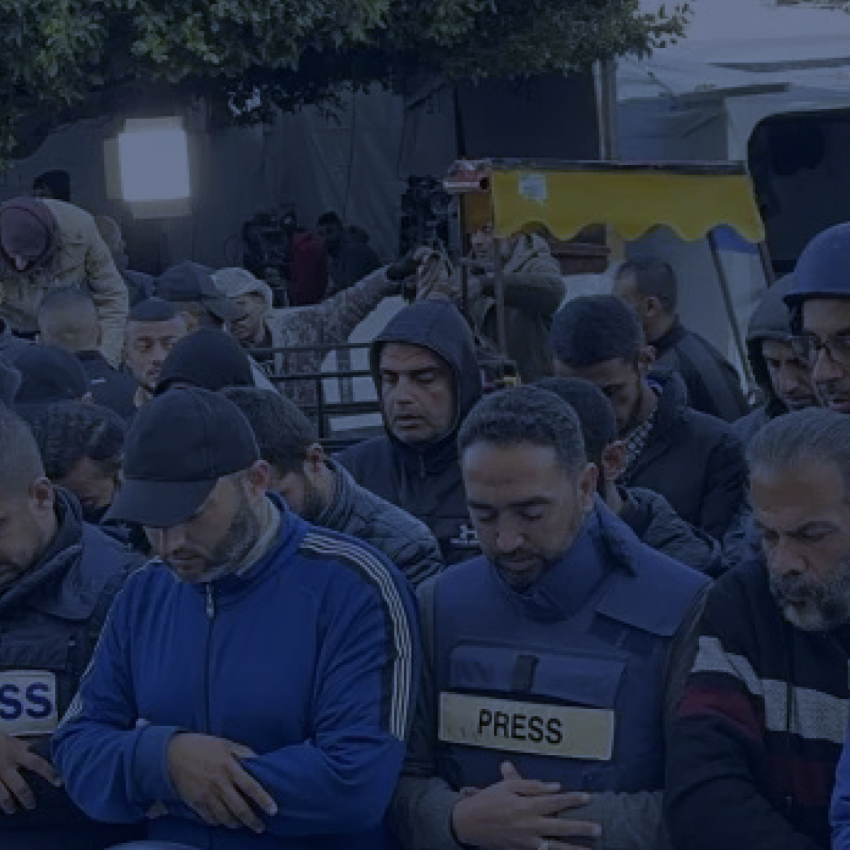
The Israeli army deliberately targeted journalists and photographers in Lebanon, killing five of them, injuring four others, and destroying the headquarters of four media outlets. More than 15 other violations were also reported. In Gaza, a journalist was killed and several members of her family were injured when an Israeli tank shelled their tent. Meanwhile, in the West Bank and the 1948 Territories, Israeli attacks targeted 14 journalists, six photographers, and one artist. In Jordan, summonses returned to the forefront, accompanied by detention and bans, while similar measures affected three media platforms in Syria.
Below is a detailed summary of the violations monitored by the Samir Kassir Foundation’s SKeyes Center for Media and Cultural Freedom in Lebanon, Palestine, Syria, and Jordan.
In Lebanon, the Israeli army carried out a series of deliberate attacks against journalists and media institutions. Five media professionals were killed: freelance photographer Mohammad Shehab and his daughter (03/12); Al-Manar TV political programs director Mohammad Sherri and his wife (03/18); Al-Manar correspondent Ali Shuaib, his colleague photographer Mohammad Ftouni, and his sister, Al-Mayadeen correspondent Fatima Ftouni (03/28). Four others were injured: Al-Akhbar newspaper photographer Haitham Moussawi (03/09), freelance photographer Kount Hajo (03/13), RT correspondent Steve Sweeney, and his colleague videographer Ali Reda Sbaiti (03/19). The Israeli army also destroyed the headquarters of Sawt Al-Farah radio station in Tyre (03/02), the buildings of Al-Manar TV and Al-Nour radio in Beirut’s southern suburbs (03/03), and the headquarters of Al-Saksakieh news website (03/06). Meanwhile, Al Jazeera correspondent Mazen Ibrahim, Red TV correspondent Rola Atwi, and Al-Mayadeen correspondent Ali Ahmar survived a second Israeli airstrike on the Qasmiyeh bridge while covering the damage caused by the first strike (03/22).
Also this month, pro-Hezbollah civilians assaulted France TV journalist Raphaëlle Duroselle and her producer, who requested anonymity (03/12), while others attempted to attack MTV correspondent Alain Dergham and his colleague videographer Fadi Skaff (03/04). The “Dahiyeh neighborhood committees” also imposed a blanket ban on filming in the southern suburbs area and threatened to confiscate phones and cameras (03/25). Journalist and political writer Marwan Al-Amin (03/05), media figures Ghada Eid (03/06) and Dima Sadek (03/08), and journalist Nabil Mamlouk (03/24) were accused of treason by Hezbollah supporters and received online death threats. MTV and several of its staff were also threatened by supporters of the same political party, while the channel’s website was targeted in a cyberattack (03/16). In addition, the official Telegram accounts of Al-Mayadeen TV (03/07) and the Lebanese Forces website (03/15) were hacked.
Moreover, army intelligence detained rapper Jaafar Touffar for four days after summoning him for investigation over a video criticising the positions of President Joseph Aoun and Prime Minister Nawaf Salam (03/10). Seven pro-Hezbollah lawyers filed a complaint before the Public Prosecutor against MTV, represented by its chairman Michel Gabriel El Murr, and journalist Mariam Majdoline Lahham over a report alleged to have contributed to an Israeli strike by revealing sensitive information (03/16). Eight others filed a complaint before the military prosecution against journalist Sabine Youssef, claiming that a video she published constituted “contempt of the military judiciary and defamation of an official judicial body” (03/17).
In the Gaza Strip, freelance journalist Amal Al-Shamali was killed, and several members of her family were injured when an Israeli tank shelled the tents where they had taken refuge in Nuseirat camp in central Gaza (03/09).
In the West Bank, Israeli forces targeted several media professionals with stun grenades, including Quds Network correspondent Abdullah Bahesh, Palestine Post correspondent Mujahid Tabnaja, and Roya TV correspondent Hafez Abu Sabra, along with his colleague photographer Mahmoud Fawzi, who was detained, beaten, and had his camera confiscated (03/02). Israeli forces also arrested freelance photographer Abdul-Karim Al-Alami (03/10), writer and journalist Lama Deeb Khater (03/23), and freelance journalist Aysar Al-Barghouthi (03/25) after raiding their homes. Karama Radio correspondent Salman Abu Aram was likewise detained and prevented from covering developments (03/25).
In the 1948 Territories, Israeli police arrested freelance photographer Mohammad Abu Sneineh, confiscating his phone and camera (03/19), as well as artist and writer Majd Assadi after raiding his home on suspicion of publishing “inciting content” (03/02). They also obstructed the work of Al Arabiya correspondent Marwan Othmaneh and his colleague videographer Abdullah Ibrahim (03/05), Anadolu agency correspondent Samir Abdul-Hadi (03/05 and 03/17), and Al-Ghad TV correspondent Razi Tatour along with his colleague videographer Sohaib Salhab (03/17), while they were covering the fall of Iranian missiles in Haifa. Police also prevented photographer Abdullah Ibrahim from covering prayers near Al-Aqsa Mosque (03/12). In a separate incident, police officers, together with border guards, beat CNN correspondent Abeer Salman, Anadolu correspondent Fayez Halawa and his colleague photographer Mustafa Al-Kharouf, as well as a Xinhua correspondent who requested anonymity, before detaining them while they were covering prayers near Bab Al-Sahira in Jerusalem (03/17).
Additionally, an Israeli settler disrupted the work of Roya TV correspondent Ward Qarqara while he was covering missile interceptions in the Galilee (03/12), while Israeli right-wing groups carried out a smear campaign against Al-Araby TV correspondent Ahmad Darawsheh on Telegram (03/24).
In Syria, the Ministry of Information issued a circular banning the Hashtag, Jusoor News, and Al-Dalil platforms from carrying out any media activity within Syrian territory on the pretext of “not obtaining proper licensing from the Directorate of Press Affairs.” The ministry warned that “any individual or legal entity engaging with these platforms in any form would be subject to legal prosecution,” and called on all media institutions and platforms to “complete licensing procedures in accordance with applicable laws and regulations” (03/25).