


 Saturday , 12 January 2013
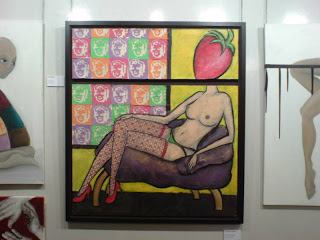
“Leaving doesn’t mean I’m abandoning it,” Dima Mabsout says about Beirut. “I really want to come back at some point and bring back what I’ve learned.”
Mabsout is a second year art student at Central St. Martins University in London. She grew up in the neighborhood of Ras Beirut. “All my life I’ve been doing it on the side just as a hobby,” she says about art, “but I never gave it that much of a focus.”
That changed when Mabsout enrolled in an art class for the International Baccalaureate program at the private secondary school she attended in Beirut. The class was like a journey with one project following another, she says. It led her to take art more seriously and pursue it in university.
Mabsout’s exposure to art in secondary school is rare in Lebanon. “In general, education in the Lebanese system does not put emphasis on art or music,” she explains.
Before deciding to pursue art school abroad, Mabsout enrolled at the American University of Beirut as a graphic design student for one year. The graphic design program was as close to an art program as she could find in Lebanon, but it was geared towards advertising and marketing.
Now, Mabsout is experimenting with film, installation art, performances, and painting in her courses at Central St. Martins University. The themes she experiments with have to do with freedom of the human spirit and the battle it has with the restraints of society. However, her style and the subjects she addresses in her art are still in flux. “I’m still trying to figure out the answers to what it all means,” she says.
The themes Mabsout explores are reflected in her thoughts on artistic expression in Lebanon. “Technically we do have freedom of expression, but I feel it is politically oriented or religious,” she says. “We do have a lot of restrictions.” If artists address a controversial political subject in their art there could be repercussions. “You have to find a balance to express your idea,” she adds.
The environment in London is more supportive of the arts and artists, Mabsout says. In Lebanon she felt very restricted. “Every time I wanted to do something I hit a wall,” she complains. “We need to find a way to climb over it or break it.”
“There is no room for expression, or very little room,” Mabsout continues. “There is no public space for people to come together and interact.” The art scene that does exist is very isolated. “There is very much distance between the public and the art world,” she says. “There is no education or appreciation for it by the general public.”
Most people are too busy worrying about the basics to spend time engaging with art. “They have electricity to worry about, or they are worrying about the next civil war. Everyone is on edge,” Mabsout adds. “Once you are comfortably surviving you start exploring the cultural side.”
Exploring culture and creating art was a luxury that her parents’ generation did not have, Mabsout says. As a result, Mabsout’s generation, the generation born right after the end of the Civil War, was not raised with an appreciation for art for the most part.
Now, Beirut’s culture is more about drinking than art, Mabsout continues. When people in London find out she is from Beirut they tell her they have heard Beirut is a good place to go party. “It’s a party culture,” she concludes.
However, every time Mabsout returns to Beirut she sees more going on in the cultural community. “It makes me want to come back even more and join in,” she says. “People are starting to realize the importance.”
Art can bring people together and help create a collective and at the same time make space for individual identity, Mabsout says. “If people can start expressing themselves artistically instead of using violence or insults, I think it will enrich the culture, but it will enrich the living standards as well.” She adds, “It’s a very good vent.”
Mabsout is planning a project called The Naked Wagon with the idea of taking art from closed circles and bringing it to the public.
The plan for the project is to have an actual wagon pulled by two bicycles that will function as a mobile, interactive art installation. “I want to break the seold_paration between the artist and the public,” Mabsout says.
Mabsout wants the project to be a space for collaborative art regardless of political or religious divisions. “I’m feeling people are starting to come together and are really hungry for artistic expression,” she says. “That’s what this country needs right now. It needs people to unify… We need to create new values and beliefs. Public art collaboration has a role to play in this process.”
For now, Mabsout is spending most of her time in London where she is trying to start the Naked Wagon. She hopes to bring the project back to Beirut with her when she returns either after her undergraduate studies or after finishing a master’s degree. “It will have so much more to give to the culture here… We should start collectively creating the future,” she says.
You can follow Mabsout’s artistic explorations at her blog.
Eric Reidy is a
project assistant at the SKeyes Center for Media and Cultural Freedom
researching and writing about the cultural scene in Beirut. This article is
part of a regular interview series with artists living, working, and creating
in Beirut.
Previous articles:
·
“Beirut
has a special magic”: An interview with Syrian artist Gylan Safadi
·
“Our
culture is dying”: An interview with Mohamad Hodeib
·
“It’s
a place for music… Beirut”: An interview with Bilad El-Sham